In the high-stakes arena of global statecraft, three hours is usually a mere preamble. Yet, the recent visit of the UAE president to India was a masterclass in hyper-efficient diplomacy, where a compact window of time yielded a decade’s worth of strategic momentum. This “three-hour magic” has not only solidified the existing bond between these two nations but has effectively architected a new era of bilateral synergy. For the geopolitical observer, it signals a pivot toward a high-velocity partnership that is rapidly transcending traditional diplomacy to build the technological infrastructure of the future.
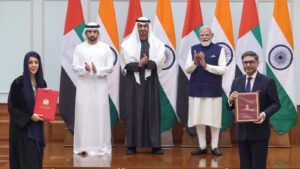
INDIA & UAE joint statement
Beyond Borders: The Virtual Trade Corridor:
The announcement of a UAE virtual trade corridor for India represents a tectonic shift in global logistics. We are witnessing the decoupling of trade from its traditional physical bottlenecks. This digital-first architecture is designed to bypass maritime friction, streamlining economic ties through a seamless, tech-enabled interface.
Moving toward a virtual trade corridor simplifies the complexities of cross-border movement, allowing for more agile and resilient economic bridges. By prioritizing this “invisible” infrastructure over a singular reliance on physical ports, India and the UAE are engineering a commerce model that anticipates the demands of a post-physical world.
Supercomputing and the AI Revolution:
This alliance is aggressively architecting the backbone of the Global South’s compute sovereignty. Through joint initiatives in UAE HPC (High-Performance Computing) and the development of a dedicated artificial intelligence computer, both nations are future-proofing their economies.
* High-performance computing is the new “oil” of the digital age.
* The partnership transforms data-rich environments into insight-driven powerhouses.
* Collaborative AI development ensures both nations remain at the vanguard of the Fourth Industrial Revolution.
* By pooling supercomputing resources, India and the UAE are positioning themselves as the primary architects of the global AI landscape.
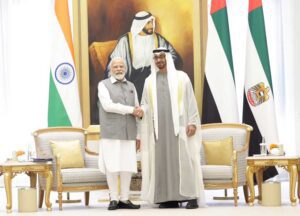
INDIA & UAE LEADERS
To the Stars: Rocket Launching and Space Cooperation:
The frontier of this partnership extends into the cosmos, anchored by “Spaceific” initiatives—a targeted strategic framework designed for the galactic sector. The collaboration on UA rocket launching represents a decisive departure from a historical reliance on legacy space agencies. This technical synchronicity is the physical manifestation of the rapport built on the ground, proving that the alliance is as much about the stars as it is about terrestrial trade.
When two emerging powers pool resources for space exploration and satellite deployment, they create a new center of gravity in the aerospace technology sector, challenging the established global order.
Reading Between the Lines: The Power of Body Language:
To a seasoned geopolitical analyst, the most profound data points are often non-verbal. The UAE body language observed at the airport during the visit was a loud signal to global observers. This was not merely a matter of protocol; it was a visible manifestation of high-level trust that solidifies regional strategic objectives.
In international relations, body language is a critical, often overlooked metric. The rapport displayed between the leaders serves as a force multiplier for written treaties. This visible chemistry suggests a deep-rooted alignment that goes beyond ink on paper, signaling to the world that the solidification of this partnership is personal, professional, and permanent.
Conclusion: A Blueprint for the Future:
The brief yet impactful visit of the UAE President to India provides a blueprint for 21st-century statecraft. By integrating virtual trade, compute sovereignty via HPC, and Spaceific exploration, both nations are transcending traditional geographic and economic boundaries. They are no longer just participants in the global market; they are the designers of its new framework.
The 3-Hour Advantage: Why India-UAE Collaboration Is the Future of Global Trade & Innovation
In the high-stakes arena of global statecraft, three hours is usually a mere preamble. Yet, the recent visit of the UAE president to India was a masterclass in hyper-efficient diplomacy, where a compact window of time yielded a decade’s worth of strategic momentum. This "three-hour magic" has not only solidified the existing bond between these two nations but has effectively architected a new era of bilateral synergy. For the geopolitical observer, it signals a pivot toward a high-velocity partnership that is rapidly transcending traditional diplomacy to build the technological infrastructure of the future.
INDIA & UAE joint statementBeyond Borders: The Virtual Trade Corridor:
The announcement of a UAE virtual trade corridor for India represents a tectonic shift in global logistics. We are witnessing the decoupling of trade from its traditional physical bottlenecks. This digital-first architecture is designed to bypass maritime friction, streamlining economic ties through a seamless, tech-enabled interface.
Moving toward a virtual trade corridor simplifies the complexities of cross-border movement, allowing for more agile and resilient economic bridges. By prioritizing this "invisible" infrastructure over a singular reliance on physical ports, India and the UAE are engineering a commerce model that anticipates the demands of a post-physical world.
Supercomputing and the AI Revolution:
This alliance is aggressively architecting the backbone of the Global South’s compute sovereignty. Through joint initiatives in UAE HPC (High-Performance Computing) and the development of a dedicated artificial intelligence computer, both nations are future-proofing their economies.
* High-performance computing is the new "oil" of the digital age.
* The partnership transforms data-rich environments into insight-driven powerhouses.
* Collaborative AI development ensures both nations remain at the vanguard of the Fourth Industrial Revolution.
* By pooling supercomputing resources, India and the UAE are positioning themselves as the primary architects of the global AI landscape.
INDIA & UAE LEADERSTo the Stars: Rocket Launching and Space Cooperation:
The frontier of this partnership extends into the cosmos, anchored by "Spaceific" initiatives—a targeted strategic framework designed for the galactic sector. The collaboration on UA rocket launching represents a decisive departure from a historical reliance on legacy space agencies. This technical synchronicity is the physical manifestation of the rapport built on the ground, proving that the alliance is as much about the stars as it is about terrestrial trade.
When two emerging powers pool resources for space exploration and satellite deployment, they create a new center of gravity in the aerospace technology sector, challenging the established global order.
Reading Between the Lines: The Power of Body Language:
To a seasoned geopolitical analyst, the most profound data points are often non-verbal. The UAE body language observed at the airport during the visit was a loud signal to global observers. This was not merely a matter of protocol; it was a visible manifestation of high-level trust that solidifies regional strategic objectives.
In international relations, body language is a critical, often overlooked metric. The rapport displayed between the leaders serves as a force multiplier for written treaties. This visible chemistry suggests a deep-rooted alignment that goes beyond ink on paper, signaling to the world that the solidification of this partnership is personal, professional, and permanent.
Conclusion: A Blueprint for the Future:
The brief yet impactful visit of the UAE President to India provides a blueprint for 21st-century statecraft. By integrating virtual trade, compute sovereignty via HPC, and Spaceific exploration, both nations are transcending traditional geographic and economic boundaries. They are no longer just participants in the global market; they are the designers of its new framework.